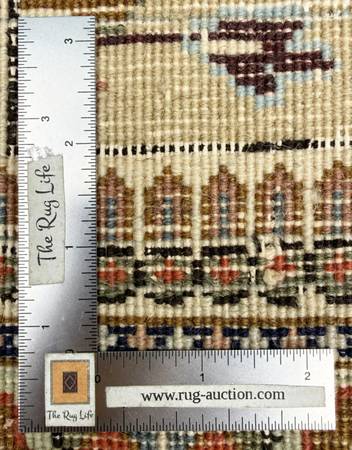
Signed Persian Tabriz rug, was hand knotted in Iran of 100% natural wool on a cotton foundation. This rug has full, wool piles and is in excellent condition. There is a cartouche (written in Farsi) woven into one end of this rug that most likely reads “Tabriz”. The finely woven structure and signed cartouche indicate a higher-grade workshop weaving in the Tabriz tradition, long regarded among the most respected weaving centers in Persia for precision drawing, refined knotting, and sophisticated floral compositions. This finely executed, signed Persian Tabriz hand-knotted rug features an exceptionally elegant coral-red field, framed by intricate ivory floral borders and refined curvilinear vine work throughout. This piece embodies the type of quiet luxury increasingly sought after by interior designers, collectors, and luxury staging professionals. No holes or repairs, plush and soft. This rug was acquired from an established rug merchant. Cleaned and ready to be enjoyed. FLAT RATE SHIPPING OF $300.00 FOR THIS RUG WITHIN THE CONTINENTAL UNITED STATES OF AMERICA. Please see all of our rugs and other items at www.rug-auction.com.
Tabriz rugs are Persian carpets from the city of Tabriz, in the Northwest part of Iran. It is one of the oldest rug weaving centers and makes a huge diversity of types of carpets. String materials are usually made of cotton, or silk which is used for very fine rugs. Tabriz has been a large and worldwide famous carpet making center in the Iran and the world. It played a significant role in development the rich traditions of the decorative and applied arts. Different types of carpets were made here, including pile and flat weave, with simple and complex composition. The carpet making art was passed on from generation to generation and was considered the most valued heirloom. The traditional topics for the Tabriz carpets are the ornamental patterns, with the following dominant background colors: cream, red or navy blue. The turanj in the center of the carpet is a symbol of the Moon, and the pattern formed by lozenges with the toothed leaves on the edges symbolizes the scales of the fish, which rise to the surface of the water at midnight to admire the Moon reflection. The origin of this composition dates back to the 9th-10th centuries. Often the topics for the Tabriz carpets are drawn from the works of the great Oriental poets. The carpets often depict the scenes of falconry or images of a ferocious lion. Well known are also Tabriz carpet-pictures with images of fragments of palaces and mosques, scenes of battles. Often, in creation of this or that ornamental pattern carpet weavers were inspired by the hand-painted covers of ancient books.